
Meet a robo-duck that walks, sits down, makes noise, and sleeps on your command. Stands up again, follows commands just like a good companion, grabs stuff with its beak, and walks adorably.
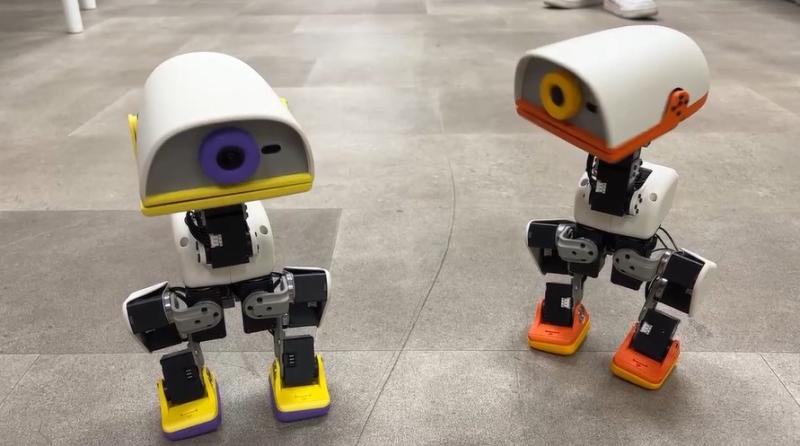
At GTC Berlin on 21st October, these Microducks were unveiled, 25-centimetre bipeds developed and marketed by Pollen Robotics. It can walk, kick, and roller skate. Each has a camera for a head, a beak, a neck and a pair of feet, and their movements are genuinely endearing. NVIDIA CEO, Jensen Huang, demonstrated a range of tricks on stage, including sitting down, somersaulting, sleeping, and walking.
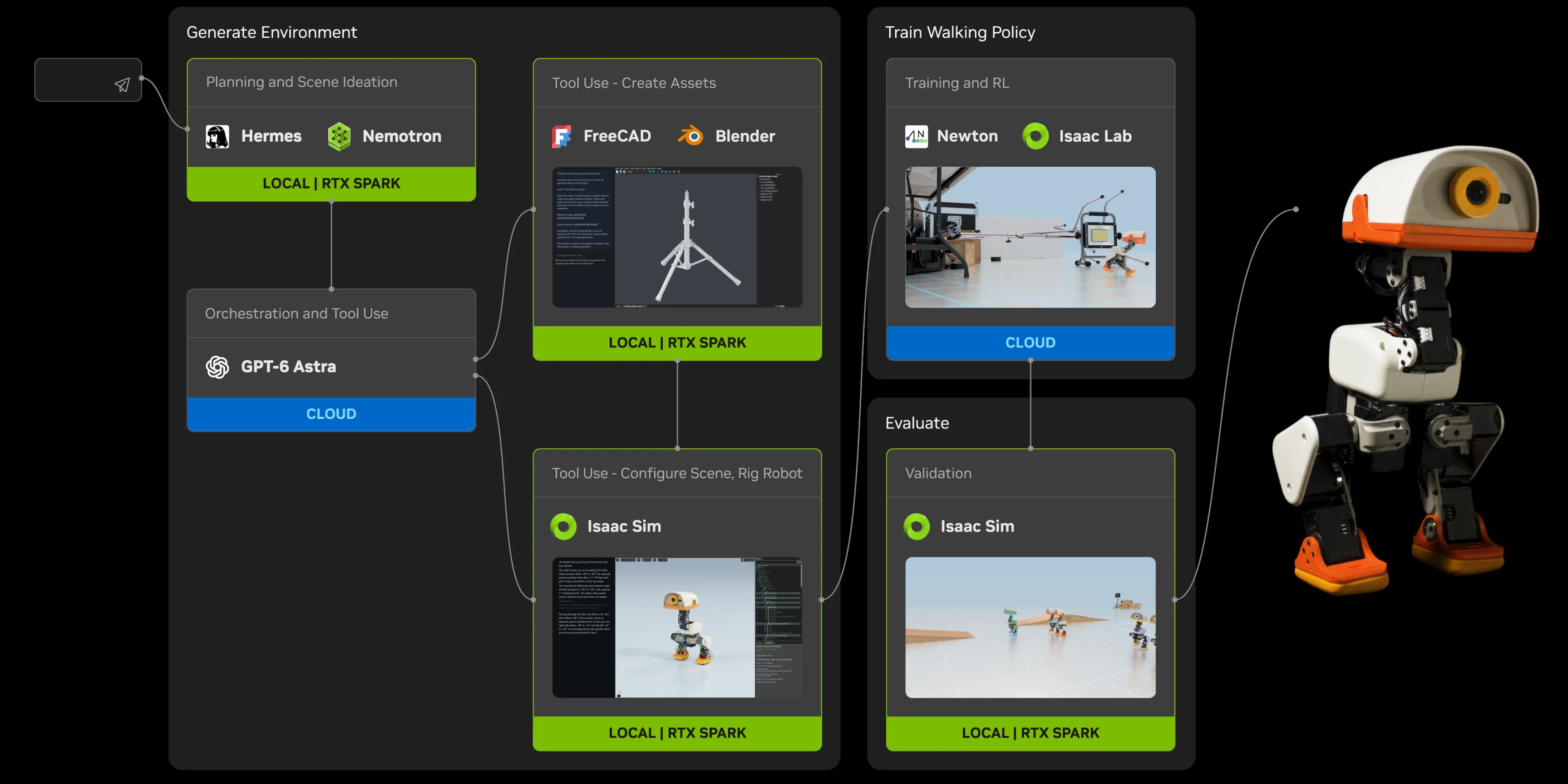
The trained Hermes agent runs the whole system, keeping every action smooth and a bit of fun. Its movement is controlled by reinforcement-learning policies running on a Rockchip RK3566 board. The subtle tumbling motion of the ducks makes them so adorable to see. The AI system of the ducks was trained in Isaac Sim simulation inside NVIDIA RTX Spark and NVIDIA Nemotron 3.5 Bolt.
The brain behind the Microducks, Nemotron 3.5 Bolt, is a vision-language model (VLM) with 74 billion parameters, 9 billion of them active.
What is a VLM?
A vision-language model (VLM) is an AI training system to understand both images and language. In a robot like the Microduck, it takes in video as its vision input and commands as input. Together, these let the robot receive a command, work out what it means and plan a sequence of actions to complete it.
For example, we command an action to the robot, first they interpret the instruction using Hermes. It then uses its RGB camera and depth sensors to scan and analyze the surroundings for the motion. Finally, the actuators carry out the movements in the sequence planned by the Hermes system.
Hermes, an AI Agent, is Nous Research’s MIT-licensed agent harness. Nous is an open-source platform for building AI agents. The agent acts as the command layer for the duck. In the Microduck, the Hermes framework coordinates the robot’s behaviour, drawing on the commands interpreted by RL training policies and the observations from the vision system to decide on an action or a chain of actions.
The AI model used to train is NVIDIA’s Nemotron 3.5 Bolt 74B-A9B, the VLM described above. It analyses commands and turns them into pretrained instructions that Hermes then arranges into a sequence of actions.
The Microduck was trained in Isaac Sim, a simulation environment that works with Isaac Lab, another NVIDIA framework built for robot learning. Isaac Lab is used to train and refine robot policies through reinforcement learning and imitation learning, with their movements refined in an Omniverse digital twin. The duck went through intensive training in a wide range of scenarios and environments, and the resulting policy was then loaded onto the real robots. This simulation training is what makes the duck so stable and endearing. To mimic real-world conditions, the simulation draws on a number of tools, including NVIDIA’s Newton physics engine.
How does reinforcement learning work here?
In reinforcement learning (RL), the robot is placed in an environment where it observes, decides how to move and acts. When it fails or can’t cope, it updates its policy based on feedback and tries again. Over many attempts, the policy improves. Isaac Lab trained thousands of simulated Microducks in parallel, and every fall in simulation improved the policy. On RTX Spark, the Hermes agents turn a prompt into a step-by-step plan for a simulated Microduck obstacle course, and trained policies return to the evaluation hub in Isaac Sim. Once training ends, the result is small. The policy is exported as an ONNX file, which the robot’s onboard runtime loads.
For example, a duck that can walk on a flat surface may struggle on a slope. Through repeated attempts and failures, the updated policy adjusts how the motors and actuators move until the duck can walk up the slope steadily. In short, while training, the reinforcement learning keeps retraining the system to handle new scenarios, and that pays off when the robot moves in the real world.
Why not a VLA model?
The Microduck’s movements were refined in Isaac Lab using a reinforcement learning (RL) policy, so its actions are already tuned to meet the motion criteria it needs. That means the VLM training doesn’t need an action component built into its architecture, as it runs on pretrained commands. Hermes carries out the whole chain of actions based on what the robot sees, so no separate action layer is required.
A vision-language-action (VLA) model training adds that action layer. It handles precise positioning and action sequences based on the specific actuators involved. Which makes the VLA to refine each action based on its vision and command. The Microduck’s actions, by contrast, were perfected in Isaac Sim through its RL control policy, and Hermes agent handles the sequencing. In practice, the Microduck doesn’t need precise positioning. It isn’t doing critical tasks like a driverless car staying in its lane, or a warehouse robot holding an exact spot to do its job.
What would be different with a VLA robot?
A vision-language-action (VLA) model training itself relied on Isaac Lab, while the VLM was also trained in Isaac sim, but the actions were trained beside VLM training with the RL control policy. In the Microduck, the VLM only sees and understands language, so Isaac Lab and its RL policy works and improves the actions. A VLA model builds that action capability into the model itself. It can analyse the whole sequence of actions and positions in real time and act on its own understanding of them.
A humanoid robot running after a VLA-training, for example, can move while processing three kinds of information at once: vision, language and action. This makes lab and simulation training of Nemotron VLM unnecessary, because the robot generates its actions directly alongside the vision and command inputs, rather than depending on a separately trained policy.
Finally, we can leave here a research question to further study the feasibility of application of VLA in such robots training: Can a compact VLA-training, fine-tuned for Microduck, or similar robots, achieve comparable task success and robustness with lower total compute, latency, and development cost than a vision-conditioned RL policy orchestrated by separate AI agents?
The Future of Robotics with Microducks
Training the Microducks in Isaac Sim, with Nemotron, Hermes and RTX Spark working together, is an efficient combination. Whether a VLA model would have been more efficient is still an open question, and answering it properly would take systematic research.
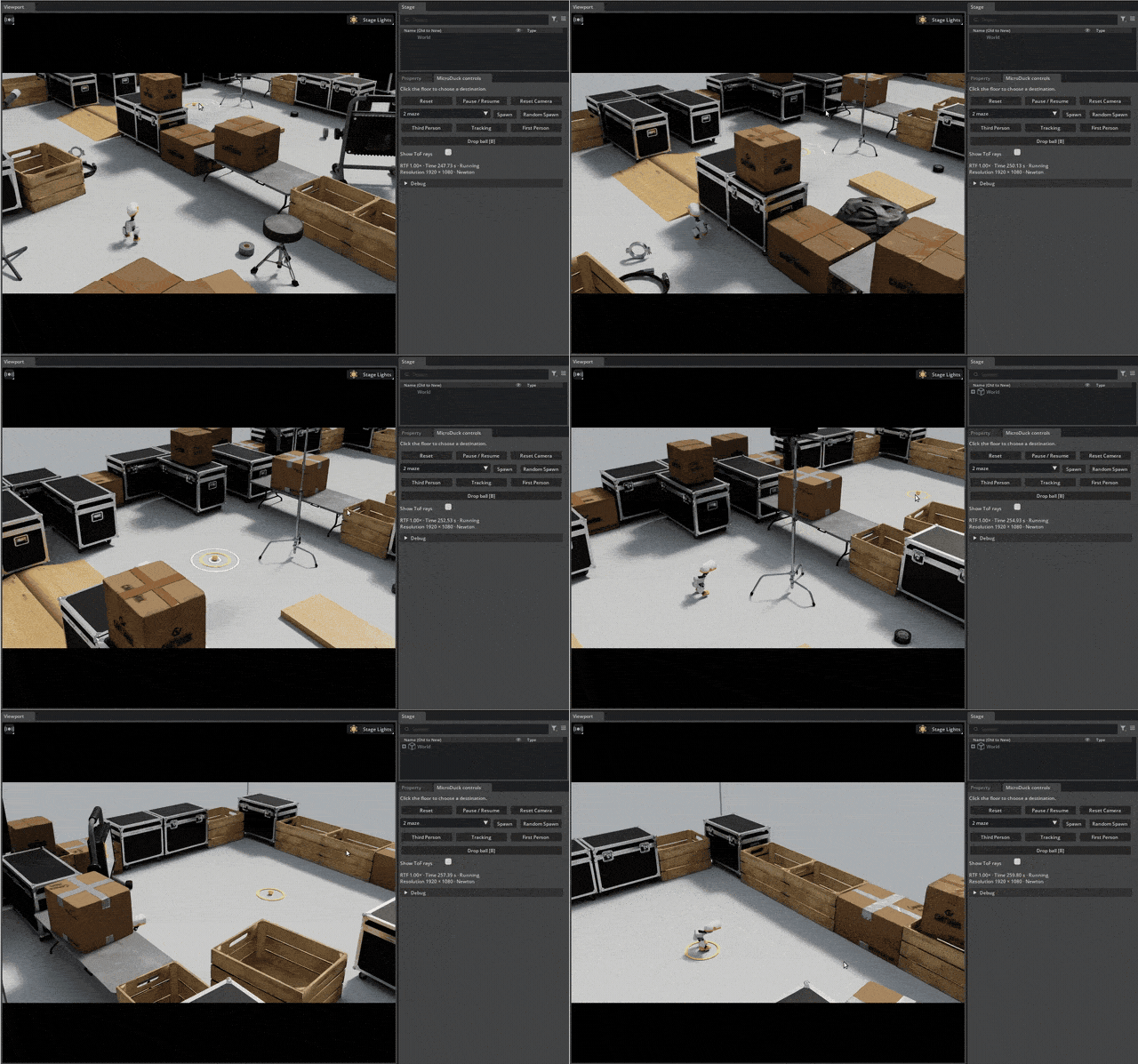
The future aspects of these combined applications of various models such as Nemotron-Isaac Sim, Hermes agent with Rocketchip Board, RTX computational training can open the window for a vast window of robotic technologies. Various combinations of agents, VLM or VLA-based models and the same pattern of agent-assisted planning, parallel simulation and compact onboard policies could carry over to delivery, agriculture and warehouse robots, etc.
VLM and VLA models are already used in training cars, humanoid robots, autonomous cars, self-driving trucks, industrial robotic arms, warehouse-household-agriculture robots, robotic drones for delivery, agriculture, filming and surveillance etc., autonomous boats, underwater exploration submarines, mining robots etc.
The more versatile the components, the more capable the finished robot can be. The more creativity we bring to the design, the better we’ll be building robots that handle multiple functions, or fill a niche that can be small but essential.