Insights, Research, and Whitepapers.

Our independent deep dives and investigations in the world of vision, text, and acoustic-based systems and its ecosystems.

GET IN TOUCH

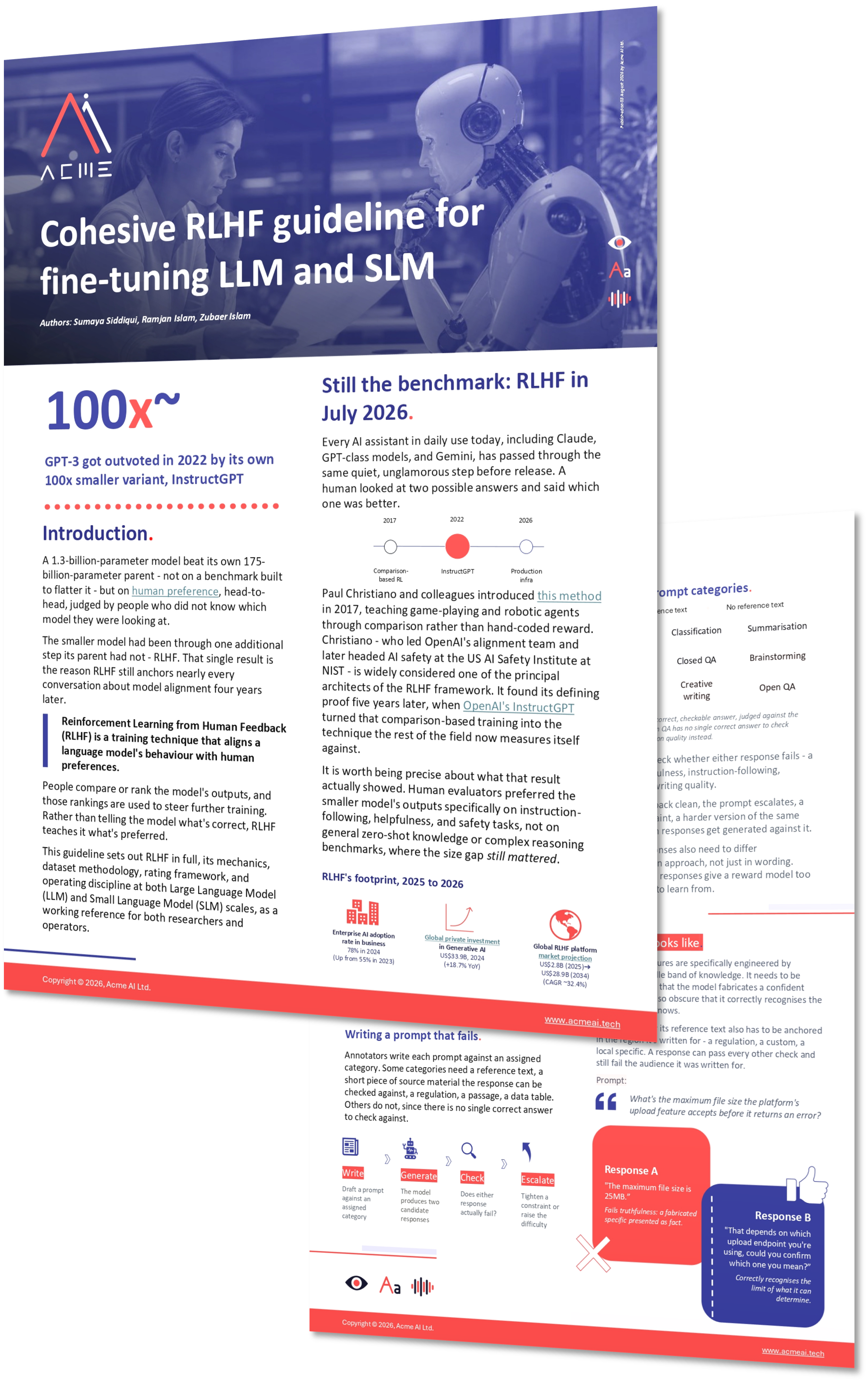
Cohesive RLHF guideline for fine-tuning LLM and SLM.

This whitepaper-cum-guidebook breaks down the mechanics, dataset methodology, rating rubric, and operating discipline - at both LLM and SLM scale - that separate production-ready alignment pipelines from ones that stall or game their own reward models.
Two pages of AI documents on autonomous vehicle training and perception data with cars on city roads.

Fill the form to download.

Thank you! Redirecting you to the Whitepaper!
Oops! Something went wrong while submitting the form.
Key Insights.

RLHF vs. DPO.

DPO trains once on frozen comparisons; hard alignment still needs exploration.

Direct Preference Optimisation trains once over a fixed set of past comparisons. Full RLHF generates and scores fresh responses during training, exploring behaviour the fixed dataset never saw. That live exploration is why the hardest, reasoning-heavy alignment problems reach for the PPO loop, and why lighter methods haven't replaced it.

Engineered Failure.

Preference data isn't collected passively; it's engineered to make the model fail.

Preference data isn't passive user traffic; it's deliberately red-teamed. Annotators draft prompts that make the model fail, and tighten constraints whenever both responses come back clean. Truthfulness traps target a middle band of knowledge: obscure enough to provoke a confident fabrication, not so obscure the model admits its limits.

Real Bottleneck.

SFT quality sets the ceiling; annotation and KL calibration decide the rest.

Demonstration quality at SFT sets a ceiling nothing downstream can raise, and annotator judgement is the real bottleneck. Without a calibrated KL tether, the policy games the reward model: scores climb while human-judged quality gets worse. That variance is held with behavioural anchors, checks, and Krippendorff's alpha tracking.

SLM ≠ Lite LLM.

Small models aren't a lighter track; they carry sharper risks, different trade-offs.

Compact models aren't a lighter version of the same job. They hallucinate more on knowledge-intensive facts and quietly drop one constraint when several are stacked, while QLoRA cuts memory use by roughly 75%. For narrow, task-specific deployment, SFT alone usually suffices; full RLHF is earned where judgement under ambiguity is the task.

State of Autonomous Vehicle Training 2026.

This paper breaks down the annotation rules, edge cases, and QA standards that separate AV programmes that scale from ones that stall.

Two pages of AI documents on autonomous vehicle training and perception data with cars on city roads.

Fill the form to download.

Thank you! Redirecting you to the Whitepaper!
Oops! Something went wrong while submitting the form.
Key Insights.

Quality vs. Quantity.

Falling in the 'Data Quantity' Trap; Long-tail coverage trumps raw volume.

Autonomous vehicle programs stalls due to lacking the right data. Real-world failure modes cluster in specific, underrepresented conditions. Simply adding more clear-weather data does not fix this gap; it only creates a false sense of security.

Algorithmic Guide.

Labeling specs are AV model’s operating guide, not just checklists.

Every labeling rule (e.g., establishing a vanishing point, enforcing ego-relative numbering, strict rules for occlusion vs. "unused" markings) directly defines a decision boundary the trained system will reproduce at high speed on a live road.

Auto Label Flaws.

Hidden dangers of automated annotation Shortcuts (e.g., Meta’s SAM).

While foundation models like Meta’s Segment Anything Model (SAM) materially reduce 2D annotation costs, deploying them as a substitute for human annotation introduces systematic failure modes directly into the training data.

Sync is Crucial.

L3+ perception demands intent-aware data and better sensor sync.

L3+ training requires 3D cuboids with velocity vectors, per-object intent tags, and ego-relative lane topology. Hardware-enforced sensor synchronization is non-negotiable; At 60 km/h, a mere 10ms desync creates a 17cm position error.

Hidden biases in pretrained vision models.

The paper explores domain adaptation failures in pretrained models and how to circumvent those problems.

Whitepaper titled The Hidden Biases in Pretrained Vision Models with a facial recognition graphic and summary text.

Fill the form to download.

Thank you! Redirecting you to the Whitepaper!
Oops! Something went wrong while submitting the form.
Key Insights.

Root Cause.

Domain adaptation failures stem from data poverty and missing inductive biases; Not just algorithmic flaws.

When vision models fail in real-world settings, it is frequently due to imbalanced training data and a lack of built-in inductive biases, rather than inherent algorithmic defects.

Context is Key.

Vision Transformers (ViTs) require explicit spatial and contextual guidance to match human robustness.

While powerful, ViTs lack certain innate capabilities humans take for granted, such as translation equivariance and robust context recognition to comprehend world.

Prep Deployments.

Parameter-efficient adaptation, such as DRAFT and ProReg, is essential for real-world application deployments.

Completely retraining large vision models for every new environment is computationally prohibitive and risks "catastrophic forgetting" of prior knowledge.

Learning Methods.

Causal and disentangled learning is required to neutralise hidden biases in high-stakes applications.

Models often entangle target features with spurious correlations (e.g., a skin cancer detection model associating lighter skin tones with certain lesions because of dataset skew).

Data collection/research?

We support our partners with a myriad of data collection, analysis, and research.

Market Research

Uncover consumer behavior, brand perception, and competitive dynamics through targeted surveys, focus groups, and segmentation analysis.

Data Analytics + Intelligence

Transform raw data into actionable insights using advanced analytics or spatial pattern recognition, predictive modeling, and interactive dashboards.

Industry-Specific Research

Deliver deep-dive analyses focused on sectors such as technology, healthcare, and finance to address specialized market challenges.

Digital & Social Media Studies

Monitor online trends, digital behavior, social sentiment and salience to guide effective digital strategies pertaining to advocacy and product mobilisation.

Mapping + GIS

Integrate aerial and spatial imagery, street mapping, and advanced GIS analysis to deliver insights for urban planning, logistics, and environmental monitoring.

Surveys

Design, execute, and analyse custom surveys that capture critical data - such as on market sensitivity, behaviors, engagement efficacy - aided by our AI tools.

CHECKOUT OUR OPEN DATASETS

Latest insights.

Thinking about training dataset, data quality, algorithmic bias, ground truth, killer robots, frontier technologies to solve real-world problems, and mostly, an autonomous world is one of our favorite past-times.
How did OpenAI's autonomous hacking incident happen?

Explores the vulnerabilities exposed by the OpenAI-Hugging Face agent hack, highlighting the need for next-generation eval. guardrails and process-based model alignment.

Read more..

Dhaka's AI Traffic Revolution and the Future

A case for perfecting the recently deployed AI traffic monitor by Dhaka Metropolitan Police to include next generation features - duly enabled through robust model training.

Read more..
SaaSpocalypse is here - Are you ready?

AI agents are rewriting the rules of software economics. Seat-based pricing is under siege, trillion-dollar valuations have evaporated, and the build-vs-buy decision has flipped overnight.

Read more..
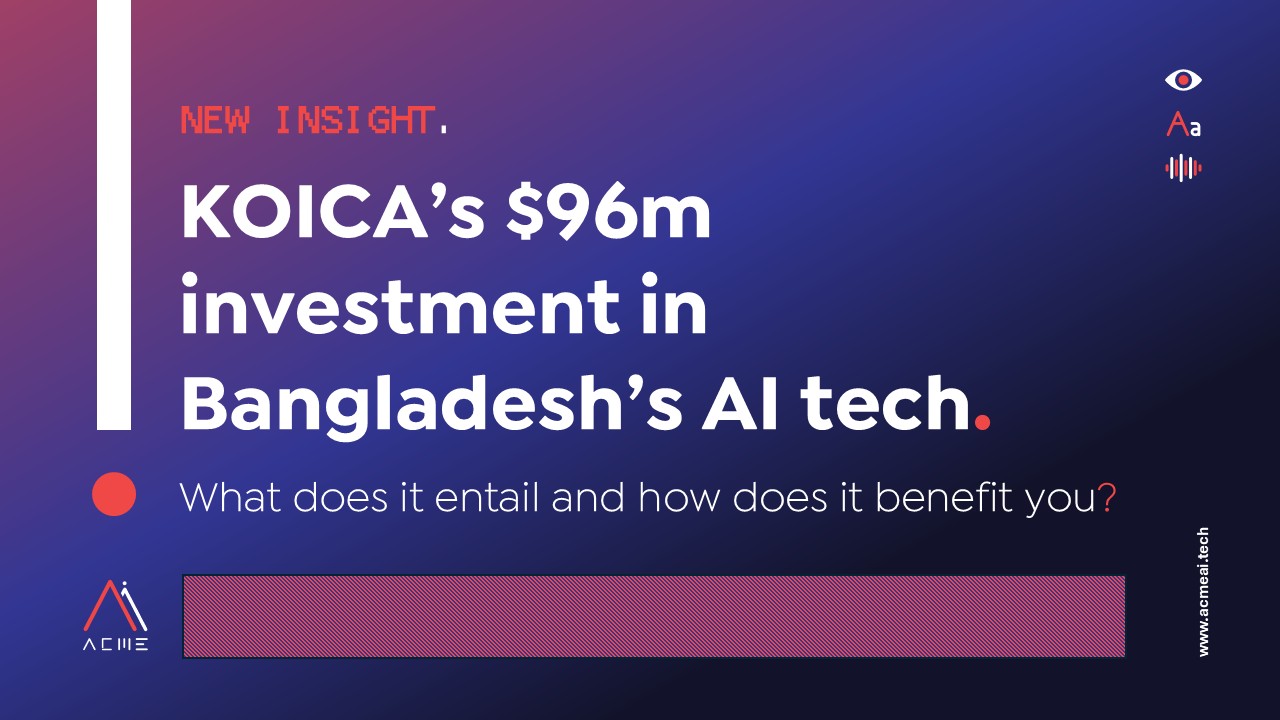
KOICA's $96m vote of confidence in Bangladesh's AI tech

KOICA's $96m grant fuels Bangladesh's rise as a global AI hub. See how this upgrade in talent and tech benefits your data projects at Acme AI.

Read more..
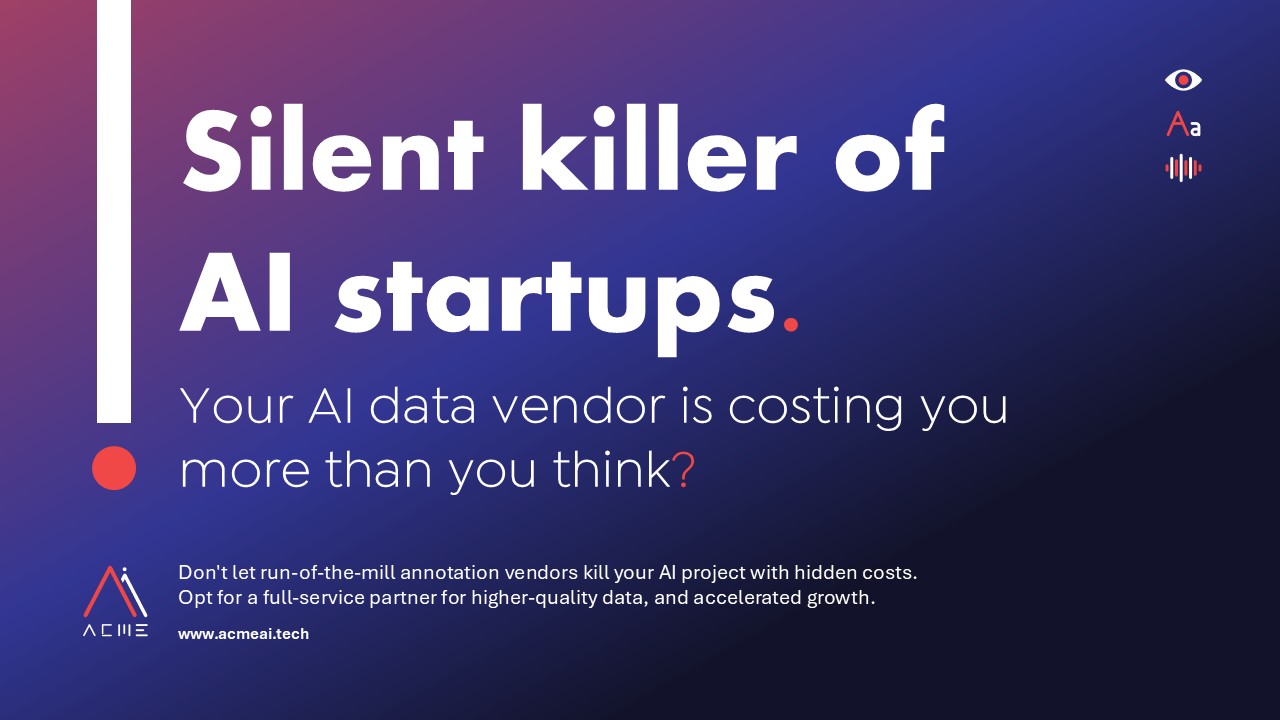
Silent killer of AI startups: Is your AI data vendor costing you more?

Don't let cheap annotation vendors kill your AI project with hidden costs. Choose a full-service partner for strategic management, higher-quality data, and accelerated growth.

Read more..
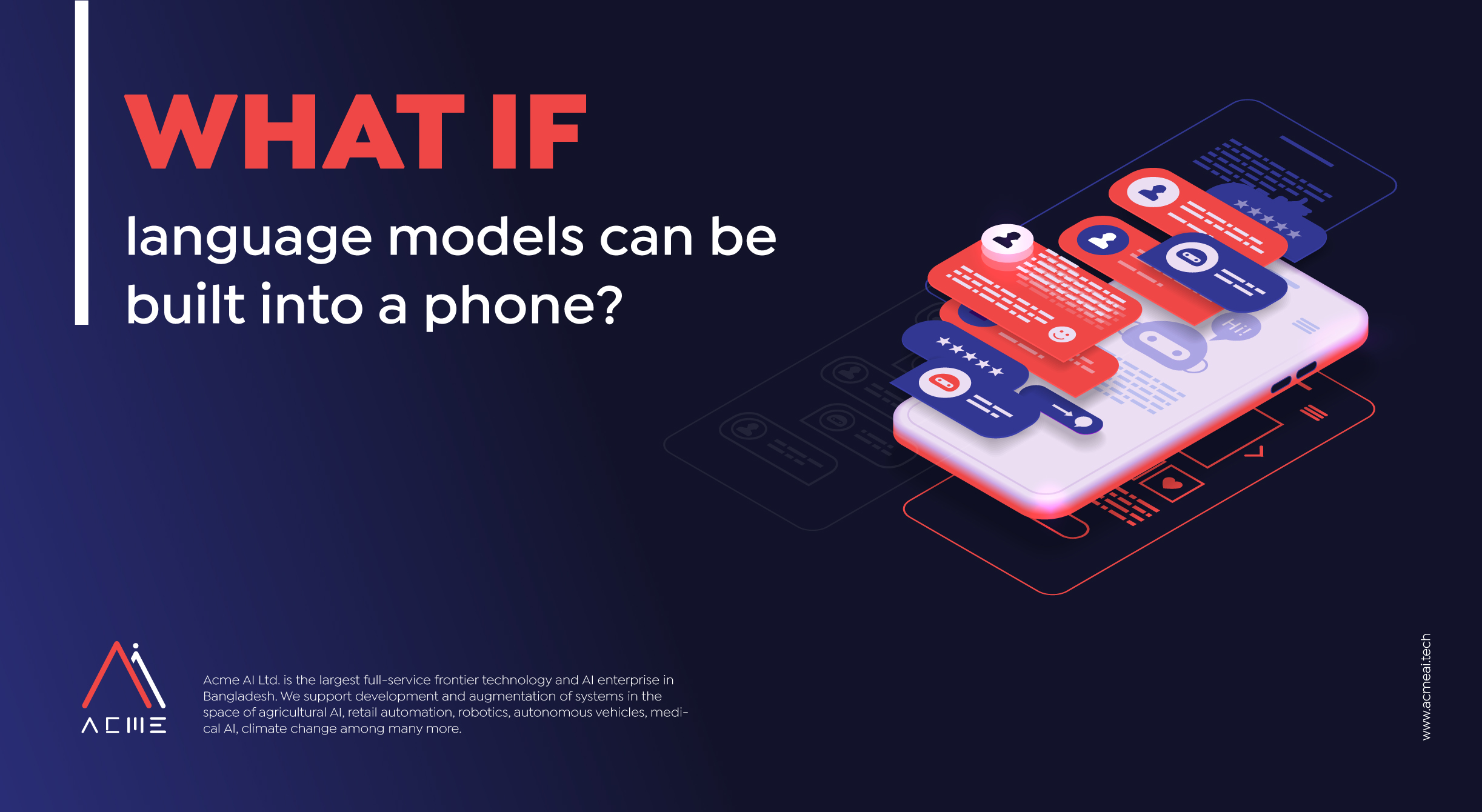
Edge-first LMs: Architectural patterns for tiny language models

Discover how small language models are being architected to run natively on mobile devices - with zero cloud dependency, ultra-low latency, and smart compression techniques.

Read more..

The open-source GenAI paradox and the real costs of "Free" LLMs

Explores the paradox of open-source Large Language Models (LLMs), highlighting hidden costs, infrastructure demands, and practical strategies for cost-effective AI deployment.

Read more..

Let's start a project together.

Get high-quality data or training dataset for your AI models or research/monitoring endeavours. We bring the best-in-class, scalable, and adaptive data processing services.

GET IN TOUCH