
.png)
For two decades, software-as-a-service was the envy of every business model in technology. Predictable recurring revenue. 70–90% gross margins. Expansion revenue that grew in lockstep with customer headcount. Investors loved it so much they piled in relentlessly - SaaS PE acquisitions hit $250 billion in 2021 alone. Then, almost overnight, the narrative flipped.
A new term is now ricocheting through boardrooms, earnings calls, and venture partner meetings alike: the SaaSpocalypse. The premise is unsettling for anyone with equity in a traditional software company - AI agents are becoming capable enough to do the work that SaaS seats were sold to enable. If an agent can update CRM records, resolve support tickets, and generate project briefs autonomously, why does a company need hundreds of per-seat licenses?
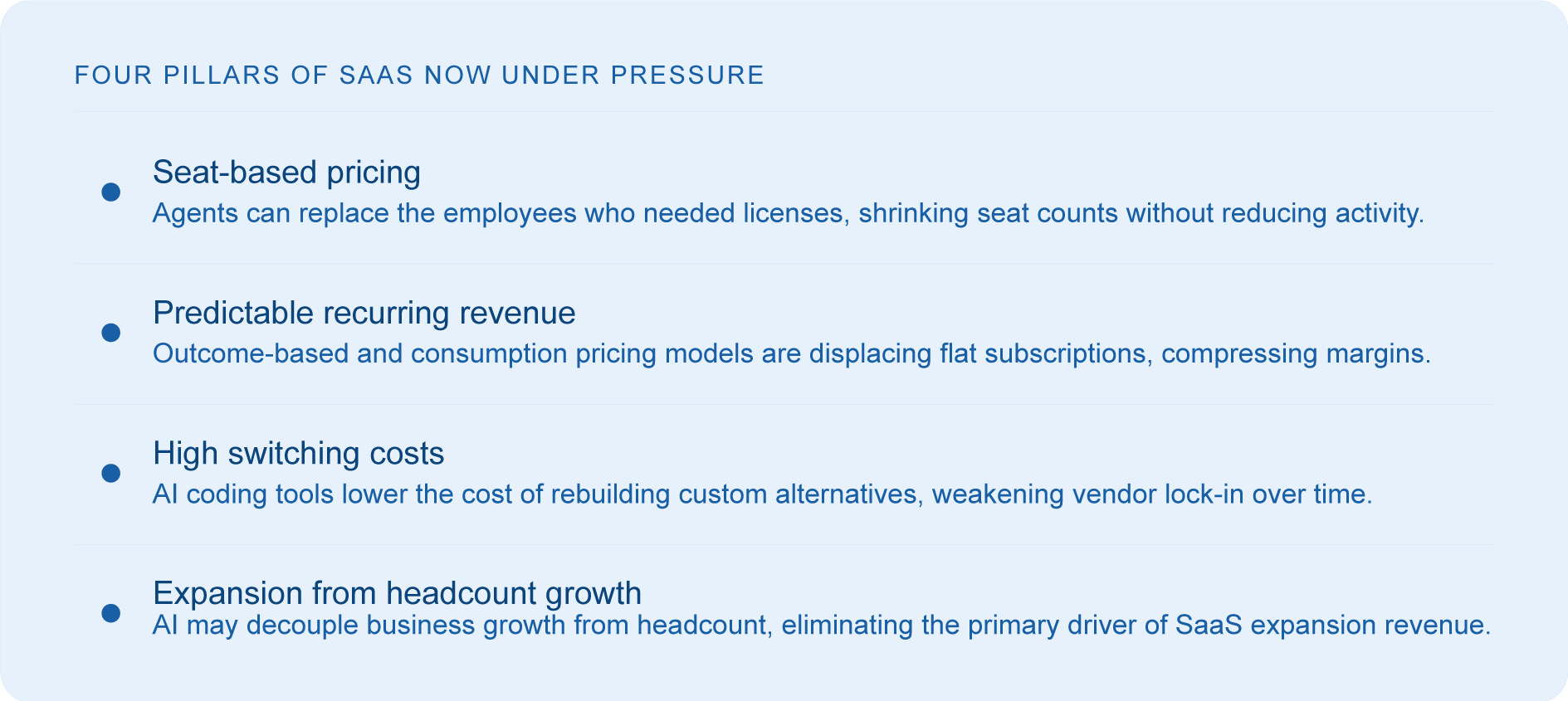
The seat-based model's existential problem
The SaaS business model was built on a simple assumption: software is used by people, and you charge per person. Headcount grows, seat count grows, revenue grows. For twenty years, this flywheel spun beautifully. AI introduces the possibility of running it in reverse.
When a single AI agent can effectively replace the work of several employees, the number of humans logging into any given platform can shrink - even as the underlying business activity stays constant or increases. A company can stay on your platform but quietly bleed seats as agents absorb the workflows that used to require human operators.
"The barriers to entry for creating software are so low now thanks to coding agents that the build-versus-buy decision is shifting toward build in so many cases."
- Lex Zhao, One Way Ventures, via TechCrunch
This isn't hypothetical. In late 2024, Klarna publicly ditched Salesforce's flagship CRM in favor of a homegrown AI system. The realization that other companies can do the same - and are actively doing so - sent shockwaves through public markets. In early 2026, a sell-off wiped between $1 trillion and $2 trillion in market value from software and services stocks, with major SaaS players like Salesforce, ServiceNow, and Snowflake all hit hard.
The 'vibe coding' threat isn't what you think
The second vector of disruption is less about AI agents replacing users and more about AI coding tools making it trivially easy to build custom software. The concern isn't one large competitor - it's thousands of small, highly targeted micro-products eating away at individual features of incumbent platforms. Some analysts have called this "not one shark, but thousands of piranhas."
The logic runs like this: modern AI coding assistants can generate functional applications from natural language prompts. An operations team that previously paid for a project-management SaaS might now spin up a bespoke internal tool in days, perfectly tailored to their workflow, at a fraction of the cost. Multiply this across enough enterprise teams and the incremental revenue pressure becomes significant.
Why the panic may be getting ahead of reality
Not everyone is convinced the sky is falling. A growing cohort of analysts and operators argue that the SaaSpocalypse narrative conflates what AI can do in a demo environment with what it reliably does in mission-critical enterprise settings - and that these are very different things.
Enterprise SaaS platforms like Salesforce, ServiceNow, and Workday aren't just feature bundles. They represent years of compliance integrations, security certifications, reliability SLAs, and battle-tested workflows serving thousands of enterprise customers simultaneously. An AI coding tool can generate a functional prototype in hours, but it cannot instantly inherit a decade of enterprise trust.
Furthermore, the direct evidence - mass contract cancellations, dramatic revenue declines, 8-K filings announcing customer departures - hasn't materialized yet for most incumbents. The market has priced in a future that hasn't fully arrived. One skeptic put it bluntly: WordPress made it easy to launch a blog on the cheap, and yet not everyone runs their own blog.
The opportunity hiding inside the disruption
For technology leaders willing to look past the fear, the same forces disrupting legacy SaaS are creating genuine competitive openings. Outcome-based pricing - charging based on measurable results rather than per-seat subscriptions - is gaining serious traction. Sierra, the AI customer-service startup co-founded by former Salesforce CEO Bret Taylor, reached $100 million in annual recurring revenue in under two years by charging on outcomes rather than seats.
AI-native companies, unburdened by legacy architecture and existing seat-revenue dependencies, are adopting and iterating at a speed that traditional SaaS organizations structurally cannot match. The question for incumbents is whether they can transform fast enough - not whether the transformation is coming.
"This isn't the death of SaaS. It's the beginning of an old snake shedding its skin."
- Aaron Holiday, 645 Ventures, via TechCrunch
What Acme AI is watching?
At Acme AI, we're tracking three structural shifts that will define which software businesses thrive over the next three years: the migration from seat pricing to consumption and outcome models; the maturation of AI agents capable of owning end-to-end enterprise workflows; and the emergence of a new competitive class of AI-native platforms built from scratch for an agentic world.
The companies that will come out ahead aren't necessarily the ones with the largest installed bases today - they're the ones treating this moment as a redesign opportunity rather than a defense problem. The SaaSpocalypse isn't the end of software. It's the end of software as a passive subscription. The next era belongs to software that earns its revenue every single day.